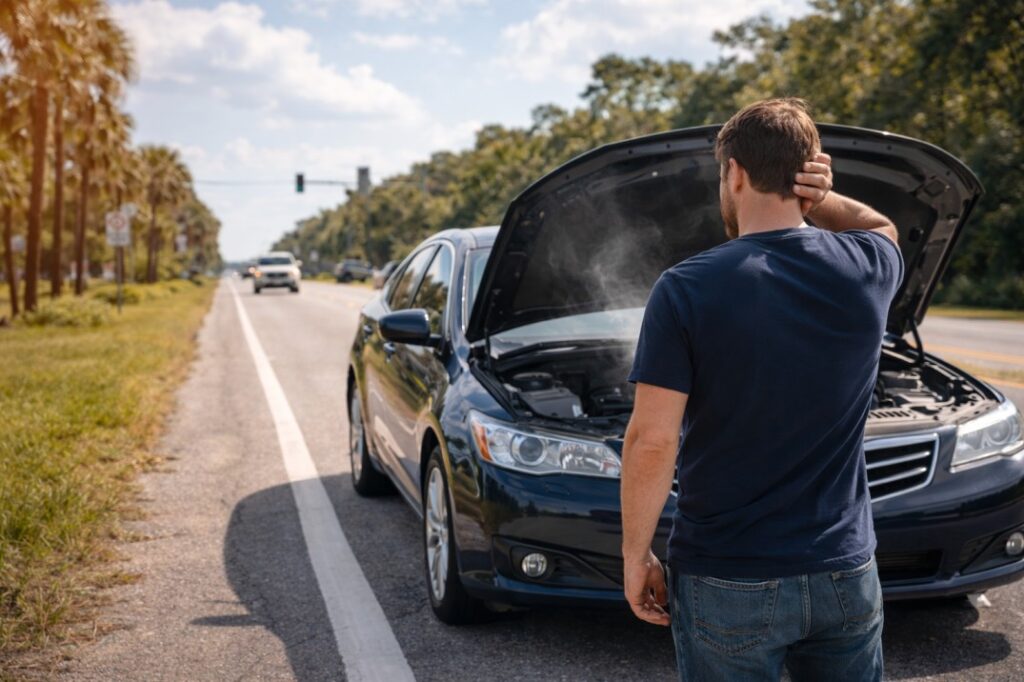
If your vehicle breaks down and you are trying to avoid the cost of a tow truck, you may be asking, can you tow a car yourself in Port Richey? It is a common question, especially when a friend offers to help or you already own a truck and basic towing equipment. Before you hook up a strap or rent a tow dolly, it is important to understand what Florida law allows and what risks come with towing a vehicle on your own.
Towing a car yourself in Port Richey is possible in certain situations, but there are legal requirements, safety concerns, and liability issues you should understand first. This guide explains what Florida law says, what equipment is required, and when calling a professional towing service is the safer choice.
If your vehicle is currently disabled, you may also want to review our guide on what to do if your car breaks down in Port Richey for step by step safety advice.
Is It Legal to Tow a Car Yourself in Port Richey
Yes, Florida law allows private individuals to tow their own vehicle in certain situations. However, legality does not mean there are no rules. You cannot simply attach a rope and drive away. The vehicle must be towed safely, properly secured, and in full compliance with Florida traffic regulations.
Florida law focuses heavily on safe operation and proper equipment. When towing a vehicle yourself in Port Richey, you are responsible for ensuring that both the towing vehicle and the vehicle being towed meet road safety standards. Any violation can result in traffic citations or liability if an accident occurs.
Under Florida traffic laws, a vehicle being towed must:
- Be securely attached using approved towing equipment such as a rated tow bar, dolly, or trailer
- Use proper safety chains when required
- Have working brake lights and turn signals that remain visible to other drivers
- Stay within the safe towing capacity of the towing vehicle
- Be operated in a way that does not create a hazard to surrounding traffic
If the towed vehicle blocks the brake lights or turn signals of the towing vehicle, auxiliary lighting must be used so drivers behind you can clearly see signals and stops. Visibility and control are key legal requirements.
In short, you can tow a car yourself in Port Richey, but it must be done safely, with proper equipment, and in accordance with Florida roadway laws. Cutting corners increases both legal risk and safety risk.
Can You Tow a Car With a Rope in Port Richey
Using a rope or chain to tow a vehicle may seem like a quick solution, but it comes with serious safety risks. While Florida law does not always prohibit rope towing outright, it must be done in a way that does not create a hazard for other drivers. In real traffic conditions, that can be difficult to guarantee.
A rope does not provide rigid control between vehicles. Sudden stops, turns, or speed changes can cause jerking motion or loss of alignment, increasing the risk of a collision.
For rope towing to be considered reasonably safe, the following conditions must be met:
- Clear visibility and communication between both drivers
- Fully functioning brakes and steering in the towed vehicle
- Very short distances at low speeds
- Proper hazard lights and visible signals
On busy roads like US 19 or Ridge Road in Port Richey, rope towing becomes especially dangerous due to traffic congestion and frequent stoplights. Law enforcement may also consider it unsafe if conditions increase risk.
While it may be possible in limited situations, towing with proper equipment or hiring a professional service is usually the safer option.
Do You Need a Tow Dolly or Trailer
If you plan to tow a car yourself in Port Richey, a tow dolly or flatbed trailer is far safer than using a rope or chain. A tow dolly lifts two wheels off the ground, while a flatbed trailer keeps the entire vehicle elevated and fully supported. Both options provide better control and reduce strain on the vehicle being towed.
Before towing, make sure:
- Your vehicle has the proper towing capacity for the load
- The hitch is correctly rated and securely installed
- Safety chains are attached and properly crossed
- The vehicle is balanced evenly on the dolly or trailer
- Tires are secured with strong straps or wheel nets
Improper setup can lead to swaying, poor braking control, or damage to both vehicles. Even with the right equipment, careful loading and weight distribution are essential for safe towing.
Can You Tow an AWD or Automatic Vehicle Yourself
In many cases, the answer is no, not without the proper equipment. All wheel drive vehicles, many automatic transmissions, and most electric vehicles are not designed to be towed with two wheels on the ground. Doing so can cause serious damage to the transmission, transfer case, or drivetrain components.
Most modern AWD vehicles require flatbed towing so that all four wheels remain off the road. This is especially important for high end vehicles that require specialized handling, which is why professional luxury car towing in Port Richey is often recommended.
Even some front wheel drive or rear wheel drive automatic vehicles have specific towing restrictions. Before attempting to tow your own car in Port Richey, always check the owner’s manual. If it states flatbed towing only, ignoring that instruction can lead to expensive mechanical damage that costs far more than hiring a professional tow truck.
Liability and Insurance Considerations
When you tow a vehicle yourself, you assume full responsibility for anything that goes wrong. If the vehicle detaches, causes an accident, or damages another car, you may be personally liable.
Insurance companies may deny claims if towing was done improperly or outside recommended guidelines. This is especially important on higher speed roads or busy intersections throughout Port Richey.
Professional towing companies carry commercial insurance and trained operators. That protection matters if something unexpected happens.
When Towing Yourself Might Make Sense
There are limited situations where towing your own car in Port Richey may be reasonable. These are typically low risk scenarios where traffic is minimal and proper equipment is available.
Towing yourself may make sense when:
- The distance is very short
- You are on low traffic residential roads
- You have a properly rated tow dolly or trailer
- Both drivers are experienced and understand safe towing practices
- The vehicle weight is within the towing capacity of your truck or SUV
Even in these situations, careful setup and slow driving are critical. One mistake in loading, braking, or turning can quickly create a dangerous situation.
If the issue is simply a flat tire, professional tire change service in Port Richey can often solve the problem without needing to tow the vehicle.
When It Is Safer to Call a Professional
In many situations, attempting to tow your own car in Port Richey creates more risk than savings. What may seem like a simple short distance move can quickly become dangerous depending on traffic, road conditions, or vehicle type. Professional towing is often the safer and more practical choice.
In situations where the vehicle does not require full towing, our roadside assistance in Port Richey can help resolve minor issues safely on site.
Calling a professional tow service is recommended when:
- The vehicle is damaged or involved in an accident
- Traffic conditions are heavy or unpredictable
- You are near highways such as US 19 or other major roads
- The vehicle requires flatbed transport
- You are unsure about towing capacity or equipment setup
- Weather conditions are poor, including heavy rain or low visibility
Professional tow operators are trained to secure vehicles properly, manage weight distribution, and navigate traffic safely. A reliable towing company in Port Richey, such as Port Richey Tow, has the equipment and experience to move vehicles without risking additional damage or safety issues. In many cases, professional assistance is not just more convenient, it is significantly safer.
What Florida Law Says About Safe Towing
Florida law places a strong emphasis on safe vehicle operation and proper towing equipment. While private towing is permitted, it must be done in a way that does not create a hazard for other drivers on the road.
If a vehicle is towed improperly, unsecured, or operated in a manner that endangers traffic, the driver can face traffic citations, liability for accidents, insurance complications, and potential vehicle damage.
Law enforcement officers have discretion to determine whether a towing setup is unsafe based on road conditions, visibility, and control of the vehicles involved. Ultimately, the standard under Florida law is safety. If the towing method increases risk to others on the roadway, it may be considered negligent and subject to penalties.
Final Thoughts
So, can you tow a car yourself in Port Richey? Yes, in certain situations and with the right equipment. However, legal does not always mean practical or safe. The risks increase significantly on busy Florida roads, and improper towing can cause expensive mechanical damage or serious accidents.
Before attempting DIY towing, weigh the cost savings against potential risks. In many cases, hiring a professional towing company in Port Richey is the safer and more reliable option.
If cost is the main concern, you can read our detailed breakdown of how much towing costs in New Port Richey to understand what typically affects pricing.
If your vehicle is disabled and you need immediate assistance, contact Port Richey Tow today. We provide safe and dependable towing throughout Port Richey and surrounding areas. Whether your car needs short distance transport, flatbed towing, or roadside support, our team responds quickly and handles the job properly. Call 727-610-2838 now for fast, reliable service.